Closing the Gaps: What the 2026 State of Cyber Risk Management Report Means for CISOs and Risk Leaders



The FAIR Institute is pleased to announce the release of the 2026 State of Cyber Risk Management Report, produced in partnership with GuidePoint Security. Now in its second year, the report draws on a survey of 400 cyber risk professionals, conducted by Hanover Research, to show how organizations measure, manage and report cyber risk today, and where they still fall short.
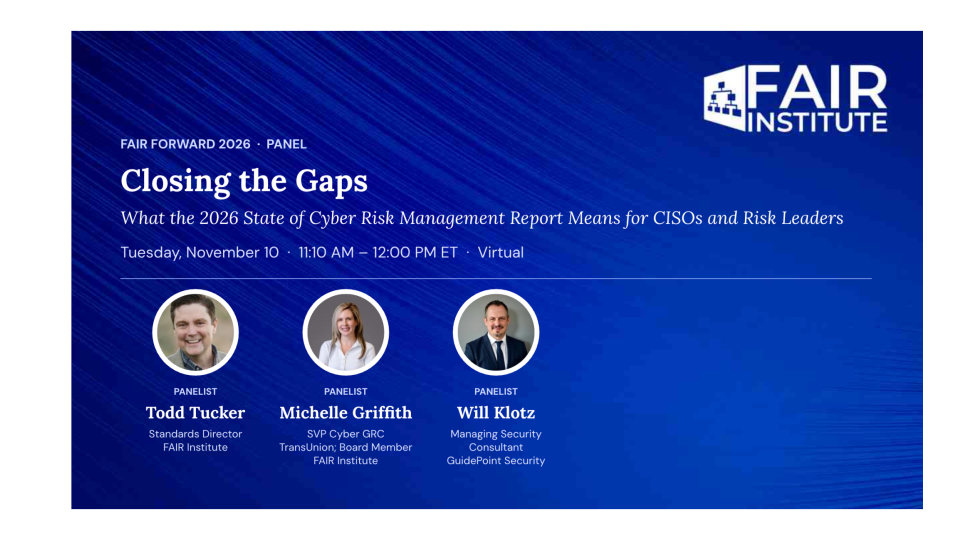
To bring the findings to life, we hosted a panel at FAIR Forward 26 on November 10. Moderator Todd Tucker of the FAIR Institute was joined by Michelle Griffith, FAIR Institute board member and GRC leader at IHG, and Will Klotz, Managing Security Consultant at GuidePoint Security and a familiar instructor in many FAIR Institute courses.
One important piece of context: respondents had to have a cyber risk management program in place to qualify. So the sample leans more mature than the market overall. The gaps the report uncovers are therefore likely even wider across the broader industry.
Here are the highlights of the discussion.
1. AI risk: use the framework you already have
Almost a third of respondents (32%) lack an AI-specific risk assessment model, even as most cyber risk teams already use AI to support their own work. Regulatory guidance remains thin, especially in the U.S., although resources such as MITRE ATLAS and the NIST AI Risk Management Framework can help.
Both panelists cautioned against "AI panic." As Will put it, mature programs already have the processes they need. The job is to bring AI into them, not to retool everything. FAIR's scenario-based approach applies equally well to new threats such as prompt injection or misconfigured LLM assistants. Michelle noted that AI also brings risks many teams have less practice with, including model risk, hallucinations, and legal and ethical exposure. That's exactly why a risk perspective, rather than a purely security perspective, matters.
The FAIR Institute is responding with a growing emphasis on AI risk, including a dedicated AI Risk working group .
2. Quantification and budget: the untapped opportunity
FAIR adoption continues to grow: 58% of respondents now use or plan to use FAIR, up from 46% last year. Risk reduction was a top outcome for 35% of all respondents, rising to 52% among those who rate themselves very successful with FAIR.
Yet only 29% cite optimized spending as a top outcome, and just 16% use quantification for budget justification, the lowest-ranked outcome in the survey.
Michelle called this a huge missed opportunity. Prioritization is the reason she adopted FAIR in the first place. Her advice is to complete risk analyses ahead of the annual budget cycle and use them to stack-rank initiatives by how much risk each one reduces. She has also used FAIR to compare competing tools. If one tool addresses five controls and another only two, is the extra risk reduction worth the price difference?
Just as powerful, she said, is using analysis to stop spending. Telling finance that you can self-fund new initiatives by redirecting money from low-impact controls earns a CISO real credibility. Few other departments come to the table with that kind of data-driven justification.
Will added that the data is already there. Teams simply need to take the extra step, "put on the financial hat," and translate risk reduction into business terms. FAIR, he said, is the translation layer between cybersecurity and the business.
3. Enabling the business, not just securing it
Risk information is widely used in the C-suite, by CISOs, CTOs, CFOs and even CEOs. But only 14% of respondents say it is used by business unit and product leaders, the people who ultimately own the risk. Integration with product development and change management is also limited. On the positive side, 24% cite faster time to market as a top outcome.
Michelle's recommendation is to train the information security officers who are aligned with each business unit in FAIR and make them your risk people. FAIR analysis ties control gaps back to real threat actors and scenarios. That turns abstract findings, such as an MFA gap flagged for two years, into a story product teams understand. And rather than handing them a thousand findings, give them the three that reduce the most risk.
Will stressed building a healthy risk culture and earning trust with business peers. That means coming with real-world data about threats targeting your sector rather than theoreticals, and being deliberate instead of charging in "like a bull in a china shop."
4. Third-party risk: from box-checking to risk reduction
Third-party risk management is nearly universal, and programs do deliver visibility into critical dependencies and better alignment among procurement, security and legal. But only 13% cite reduced residual risk from high-impact vendors as an outcome, the lowest of all. And 21% say they lack adequate data about third-party controls.
Will pointed to sheer volume. Teams get lost in questionnaires and compliance checkmarks. The FAIR lens starts with understanding which vendors are truly high-impact, and why: what they provide and what data they touch.
Michelle was blunter, calling many TPRM programs a box-checking exercise. She proposed starting from critical business data flows: where data is created, where it ends up, and which controls along the way are owned by the enterprise versus the vendor. It's the controls, not the vendor itself, that become critical. It isn't easy, she acknowledged, and AI tools can help with the scale. But it is what it takes to show real reductions in residual risk.
5. The CISO as risk leader
Most organizations have an approved risk appetite, and boards are using cyber risk information. Yet most respondents describe their governance groups as not fully effective, citing poor communication and silos.
Michelle credits FAIR with the success of IHG's program. After years of plotting risks as high, medium and low, scenario-based storytelling finally made the picture clear to the business. Her advice is to be directionally correct and focus on prioritization. Don't debate whether an impact is $42 million or $43 million.
Will recommends setting up a cyber risk committee that works as a real decision-making forum, not a slide review, with a clear charter and a strong champion. When communicating with executives and boards, he said, keep it short: the top three risks plus emerging risks, in language that matters to them.
Watch the full session and get the report
This summary only scratches the surface. Watch the full panel recording and download the 2026 State of Cyber Risk Management Report in the FAIR Institute Resource Library.
Our thanks to Michelle and Will for their insights, and to GuidePoint Security for sponsoring this research.
Not yet a member? Join the FAIR Institute as a Contributing Member to access our training, research and community of risk professionals.