The FAIR-CAM Working Group Is Here — and We Need You!


Here’s the control valuation problem the profession has never fully solved: how do you measure whether a control is working, in terms that connect directly to the risk equation?
We spend enormous amounts of energy assessing controls. We complete maturity assessments, provide self-attestations, respond to audit requests, produce heat maps. And then, when a CISO needs to justify a control investment to the CFO or the board, or an auditor needs to verify a control program is actually reducing risk, most of that work doesn't hold up. The messaging doesn't land. The language doesn't translate.
FAIR-CAM exists to fix that. The model is mature enough to deliver real value today. Some practitioners are already using it. But it isn't yet established enough to earn broad trust. There are no conformity criteria. There's no implementation guide. There are no success measures that show whether FAIR-CAM is being applied consistently and defensibly. There's no structured process for gathering field experience necessary to provide the feedback allowing it to evolve into something better.
That gap is exactly what the FAIR-CAM Working Group is here to close. And right now, in the first 90 days, the single most important thing we can do is hear from you.
What just changed
The FAIR-CAM Working Group is one of six new working groups launched under FAIR Institute 2.0, announced at FAIR Forward in November 2026. You're among the first members to hear about it, and the first with the opportunity to shape it.
You're not reading a press release about a committee that formed in private. The working group has a public charter, a formal development process, and a Standards Committee that must review and approve everything we produce. That accountability is the point. A standard that earns trust has to be built in the open, with the profession's experience baked into it from the start.
The response at FAIR Forward was immediate. Practitioners jumped at the chance to get involved. That momentum matters, and so does yours.
The mission, in plain terms
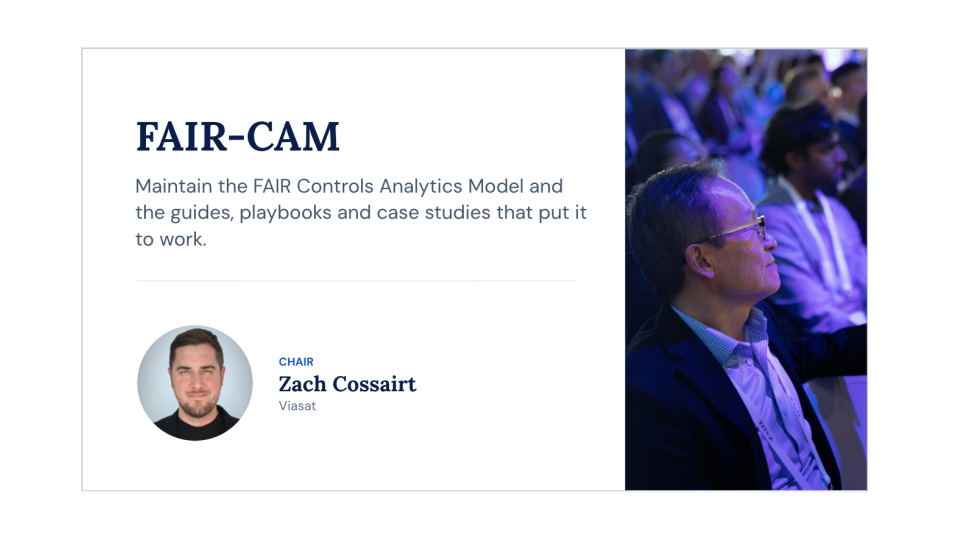
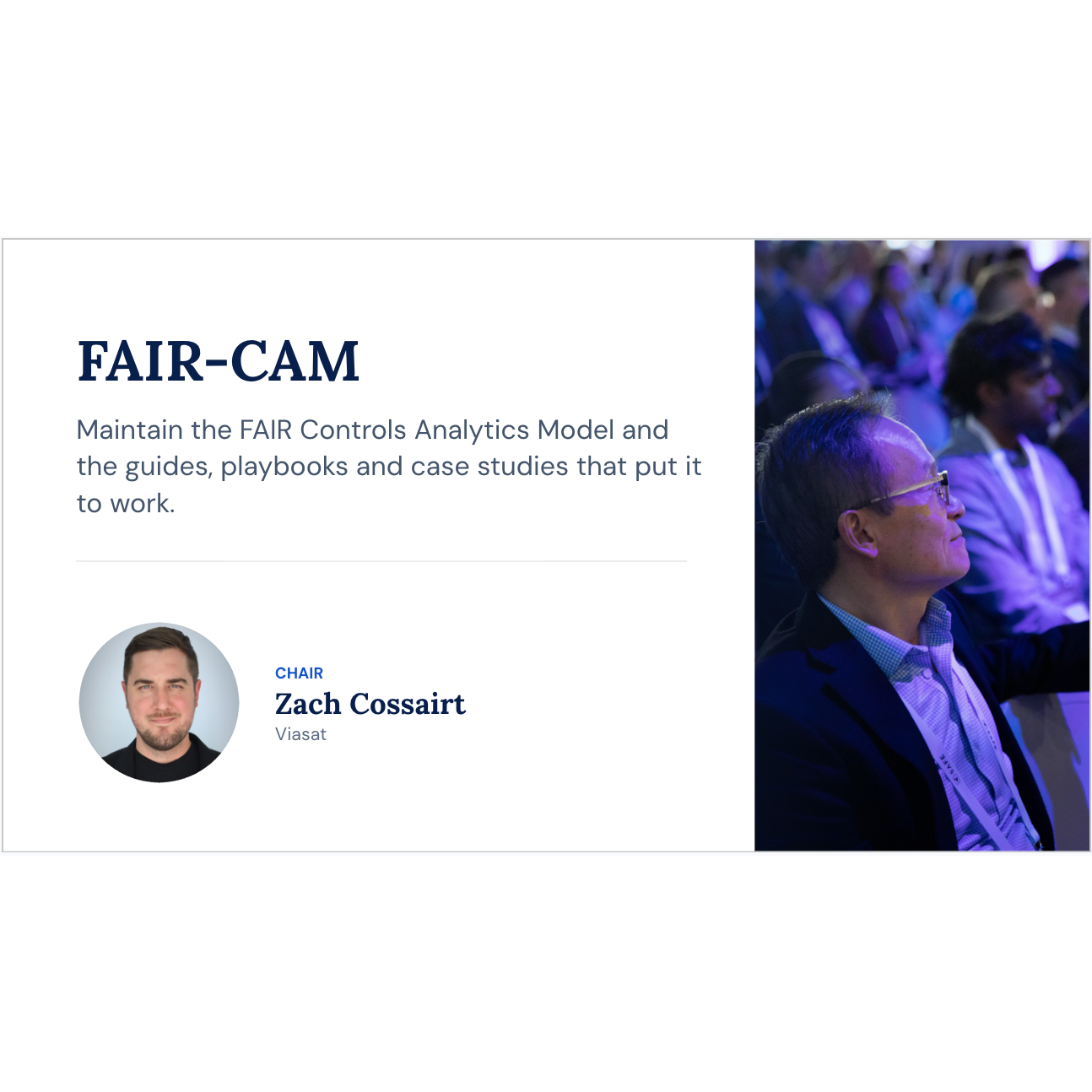
Steward and evolve the FAIR-CAM standard. Produce the guidance, playbooks, case studies, and thought leadership practitioners need to apply it consistently and defensibly.
That's it. No scope creep. No vendor endorsements. The Working Group owns the content; the Standards Committee owns the approval; the Board owns the oversight.
One important structural note: Jack Jones, the original author of FAIR-CAM, is a standing member and invaluable technical resource. The decisions, though, belong to the group.
The initial work program: five deliverables in the first 18 months
Foundation (Months 1–3)
- Success Measurement Framework: Define what "applied correctly" looks like, so we can tell the difference between activity and impact.
- FAIR-CAM Baseline Review: Assess the current standard against field experience and open issues, then propose a revision roadmap to the Standards Committee. (This is where you may come in. See below.)
Core technical work (Months 4–18)
- Conformity Criteria: The "shall" statements and test procedures that let auditors verify a FAIR-CAM application. Right now, there are none.
- Implementation Guide: A practical, step-by-step guide covering scoping, control mapping, efficacy estimation, aggregation, and investment modeling. Everything needed to actually apply FAIR-CAM in a CRQ program.
- Case Studies: Two to three published examples of organizations applying FAIR-CAM to real decisions, with traceable reasoning and documented results.
Long term (Months 18+)
- Control Framework Mappings: Map FAIR-CAM to NIST CSF, CIS Controls, ISO and NIST standards, with a defensible method for translating into control efficacy parameters.
The sequencing is intentional. The baseline review gates everything that follows. We will not write conformity criteria or an implementation guide against a model we haven't validated against the field first.
Where we need you: the FAIR-CAM Baseline Review
The revision roadmap we submit to the Standards Committee by the end of month three will only be as good as the field experience behind it.
This is the ask: share what you've seen in practice.
You don't need a formal report. You don't need a polished analysis. You need to have used FAIR-CAM, even partially, even once, and be willing to describe what happened and the issues that arose.
Specifically, we're looking for:
- Field experience: What scenario(s) did you apply FAIR-CAM to? What worked as designed? Where did you have to make judgment calls the standard didn't fully resolve?
- Open issues: Where do you see gaps, ambiguities, or inconsistencies? What questions remain unanswered after reading the standard?
We'll take everything you share and assess it against six fidelity requirements, classify each issue (normative gap, editorial clarification, or implementation ambiguity), and produce a prioritized roadmap. Your experience will be in that roadmap.
To share input: message me on LinkedIn with your desire to contribute and I’ll follow up from there with the next steps.
The Standards Committee submission window closes at the end of month three, February 2027, and I would like to have all necessary field experience and open issues documented by mid-January 2027. The earlier we hear from you, the more thoroughly we can incorporate your input.
What we're building toward
Beyond the baseline review, the vision is a profession where:
- Any organization can answer, in economic terms, which controls matter most, how well they are working, and what a change to a control is worth.
- Any auditor can test whether that answer was produced in conformity with a defensible standard.
- Any practitioner can open an implementation guide, work through a real scenario, and trust that the math is consistent with what the rest of the profession is doing.
None of that exists yet. All of it is achievable.
Other ways to get involved
If the baseline review isn't your entry point, there are two others:
- Participate as a field-test organization for the conformity criteria or implementation guide (Work Items 3 and 4). We need independent organizations to test drafts against real scenarios before submission. If your team applies FAIR-CAM, this is a direct way to influence what the final guide looks like.
- Apply for a Working Group Member seat: We have one remaining seat, open to Institute members with practical experience in risk quantification, control assessment, internal audit, or related research. This role requires a larger commitment and takes part in decisions regarding the working group’s future direction. Reach out to me if you’re interested in filling this role.
Both paths lead to the same place: a standard that reflects the experience of people who've actually used the model.
The working group is new. The standard is real. Closing the gap is achievable. Let's do it together.
Zach Cossairt is the Chair of the FAIR-CAM Working Group and a practitioner at Viasat. The FAIR-CAM Working Group was established under the FAIR Institute 2.0 initiative announced at FAIR Forward in November 2026.