Why the Next Chapter of Risk Management Is About Better Decisions, Not Better Reports
For more than a decade, the cyber risk profession has been on a journey to answer a fundamental question: Can cyber risk be measured in business terms?
When the FAIR Institute was founded, cybersecurity was still largely managed as a technical discipline. Risk assessments were often qualitative, subjective, and difficult to communicate beyond the security team. Boards struggled to understand cyber risk in the context of broader business priorities, and security leaders often lacked a credible way to explain the economic implications of cyber events and investment decisions.
The emergence of Cyber Risk Quantification (CRQ) and the FAIR model changed that dynamic. Organizations around the world demonstrated that cyber risk could be measured and quantified in business terms using structured methodologies that brought greater consistency, rigor, and credibility to risk analysis and reporting. As a result, executives and boards gained a more meaningful way to understand cyber risk and incorporate it into decision-making.
Today, however, the profession stands at another inflection point.
The Three Chapters of Cyber Risk Quantification
The evolution of CRQ can be viewed through three distinct chapters.
Chapter One: Quantification
The first chapter focused on answering a simple but transformative question: Can cyber risk be quantified in business terms? The industry’s efforts over the last decade have largely answered that question. FAIR and related approaches demonstrated that cyber risk could be measured consistently and communicated in ways that executives and boards could understand.
Chapter Two: Communication
Once organizations gained the ability to quantify risk, attention shifted toward improving communication and governance. Risk quantification became a common language that allowed CISOs, CFOs, CROs, and boards to discuss cyber risk using business-oriented metrics and economic impact rather than purely technical measures.
Chapter Three: Intelligence
Today, organizations are entering the third chapter. The challenge is no longer whether risk can be quantified or how it should be communicated. The challenge is how organizations can continuously understand changing risk conditions and translate those insights into better decisions.
This next chapter is defined by the rise of Continuous Risk Intelligence.
The Rise of Continuous Risk Intelligence
The pace of change confronting organizations today is unprecedented. Artificial intelligence is reshaping business models, accelerating innovation, and changing how organizations operate. At the same time, technology ecosystems are becoming increasingly interconnected, third-party dependencies continue to expand, regulatory expectations are increasing, and geopolitical uncertainty is influencing risk conditions in real time.
In this environment, risk is no longer static.
Yet many organizations continue to rely on periodic assessments, annual reviews, and point-in-time reporting to understand their risk exposure. While those approaches remain valuable, they are increasingly insufficient for organizations that must make decisions in rapidly changing environments.
The future of risk management is not about producing better reports. It is about enabling better decisions.
Leading organizations are moving beyond periodic assessments toward continuous risk intelligence—the ability to continuously understand how changing threats, exposures, technologies, business dependencies, and market conditions affect risk and business outcomes. Risk intelligence becomes more than a reporting function; it becomes an operational capability that informs investment decisions, governance activities, resilience planning, and innovation initiatives.
In many respects, cyber risk quantification is evolving into cyber risk management, and cyber risk management is becoming an increasingly important component of broader enterprise decision-making.
Why AI Changes Everything
No trend is accelerating this transformation more than artificial intelligence.
AI presents one of the greatest opportunities for business innovation in a generation. Organizations are rapidly deploying AI technologies to improve productivity, automate processes, enhance customer experiences, and create competitive advantage.
At the same time, AI introduces entirely new forms of uncertainty. Organizations must now understand not only traditional cyber risks, but also AI-related risks, operational dependencies, technology risks, third-party exposures, regulatory obligations, and the broader business implications of AI adoption.
The challenge is no longer simply identifying risks. The challenge is understanding risk through a common business lens that allows leaders to evaluate tradeoffs, align priorities, and make informed decisions.
This is why FAIRCON26 is centered around two strategic themes:
Governing the AI Economy
How organizations can understand, quantify, and govern AI risk while enabling innovation, accelerating adoption, and building trust with customers, regulators, investors, and boards.
One Enterprise Risk Language
How organizations are applying FAIR and quantitative risk methods beyond traditional cyber use cases to create a common framework for understanding cyber, AI, technology, operational, and third-party risk.
Together, these themes reflect a simple but powerful reality: organizations do not need more risk data. They need a better way to turn risk insights into business decisions.
A Conference for Practitioners and Executives
One of the defining characteristics of the FAIR community has always been its ability to bring together professionals who rarely participate in the same conversations.
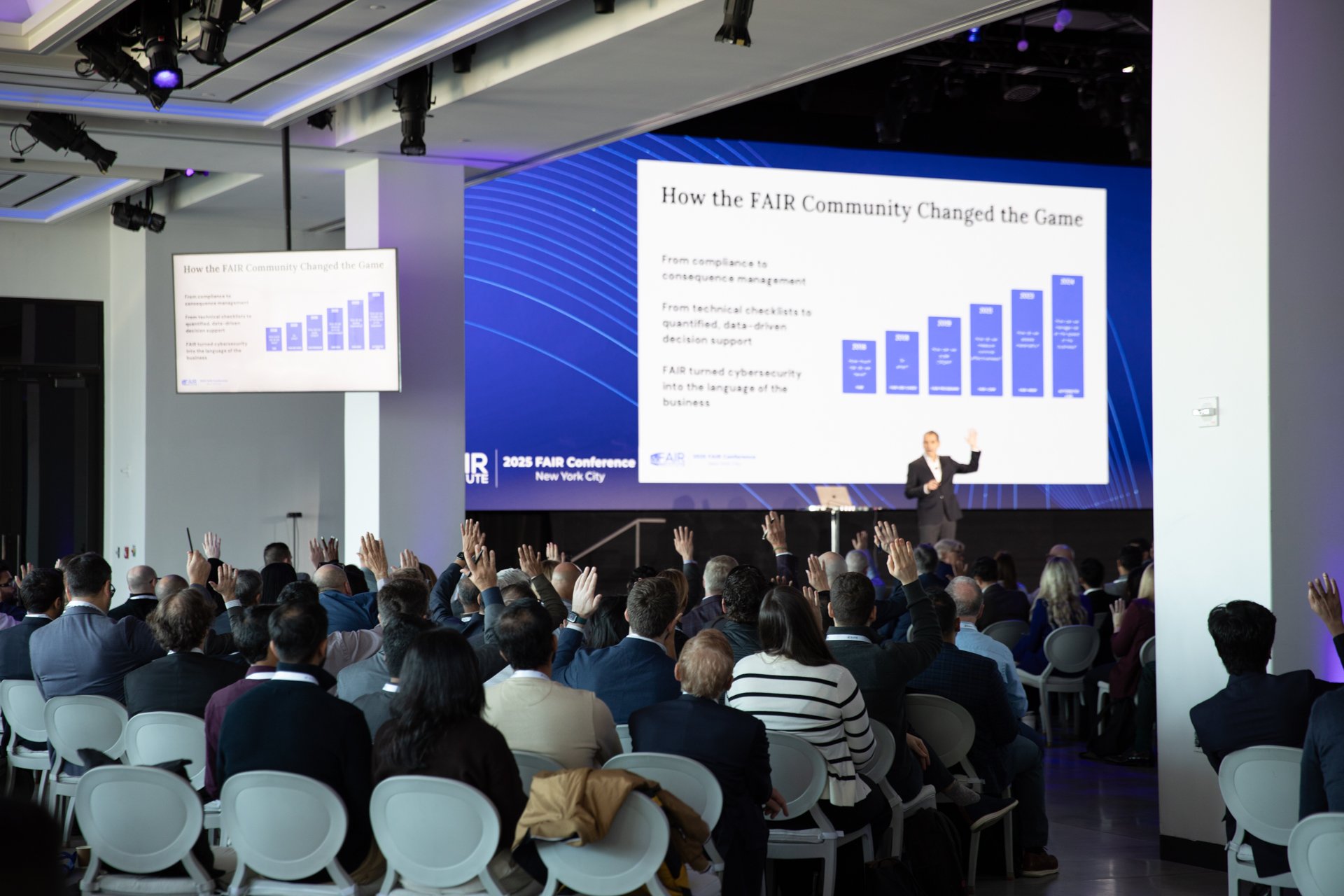
FAIRCON26 is designed for the entire risk ecosystem. The conference will feature dedicated Practitioner and CXO Tracks, ensuring that both technical practitioners and executive decision-makers gain relevant, actionable insights.
The Practitioner Track will focus on the practical application of FAIR and quantitative risk methods, including implementation strategies, analytics, assessment techniques, data collection approaches, operationalization, and real-world case studies from organizations that have successfully embedded risk quantification into their programs.
The CXO Track will bring together CISOs, CROs, CFOs, CIOs, board members, and business leaders to explore executive decision-making, AI governance, risk oversight, resilience, capital allocation, and the role of risk intelligence in driving business outcomes.
Together, these tracks create a unique environment where practitioners and executives can learn from one another and develop a shared understanding of how risk intelligence supports organizational success.
The Questions That Matter
The organizations that succeed in the age of AI will not necessarily be those with the most controls or the largest security budgets. They will be the organizations that can answer critical business questions with confidence:
- Where should we focus and invest to reduce risk most effectively?
- How do we balance innovation with resilience?
- Which risks are acceptable, and which require action?
- How do we communicate risk consistently across executives and boards?
- How do we continuously adapt to changing risk conditions?
- How do we make better decisions in the face of uncertainty?
Join Us at FAIRCON26
FAIRCON26 will bring together the world’s leading practitioners, executives, board members, academics, regulators, and thought leaders to explore the future of risk-informed decision-making.
Whether you are responsible for assessing risk, managing risk, communicating risk, or making decisions about risk, FAIRCON26 will provide the insights, frameworks, peer experiences, and practical guidance needed to succeed in the age of AI.
The organizations that thrive in the years ahead will not simply measure risk periodically. They will operationalize risk intelligence as a core business capability.
Join us in New York as we explore how to turn risk intelligence into business advantage through smarter investments, stronger resilience, more trusted innovation, and better decisions.
Early Bird registration is now open. Reserve your seat today and take advantage of discounted pricing before rates increase.
.jpg)