The publication of Gartner’s new Innovation Insight for Cyber Risk Quantification report marks an important milestone in the evolution of cyber risk management. For those of us who have spent years advocating for a more rigorous, business-aligned approach to understanding cyber risk, it is encouraging to see Gartner formally recognize both the value of cyber risk quantification (CRQ) and the direction in which the discipline is evolving. The report reflects a reality that many practitioners have witnessed firsthand: cyber risk quantification has moved from an emerging practice to an increasingly essential component of modern cyber risk management.
The Debate Is Over
For many years, the cybersecurity industry was consumed by a fundamental debate: can cyber risk actually be quantified?
While many practitioners embraced the idea that cyber risk should be measured in financial terms, others questioned whether the uncertainty inherent in cybersecurity made meaningful quantification possible. Today, that debate is largely settled. Organizations across industries are increasingly using quantitative approaches to evaluate cyber risk, justify security investments, support board reporting, and inform risk acceptance decisions.
Gartner’s report reflects this reality and acknowledges that CRQ has become an established discipline rather than an emerging concept. The industry has largely moved beyond asking whether cyber risk can be quantified. The more important question today is how quantification can be operationalized to improve business decision-making.
Recognition of FAIR’s Foundational Role
The report also recognizes the important role that the FAIR model has played in creating the foundation for modern cyber risk quantification. Gartner notes that FAIR, alongside other structured quantification methods, provided the analytical framework that enabled cybersecurity leaders to communicate cyber risk in financial terms and introduce greater rigor into cyber risk discussions.
That recognition is particularly meaningful to the FAIR Institute community, which has spent nearly two decades advancing the practice of measuring cyber risk using a common language that business leaders can understand. Today, the FAIR Institute includes nearly 20,000 members and represents more than half of the Fortune 1000. The growth of the community reflects a broader realization that cyber risk must be managed as a business risk, not merely as a technical problem.
The Next Evolution: From Quantification to Operationalization
What I find most compelling about Gartner’s analysis is that it focuses less on the mechanics of quantification and more on what comes next.
The report argues that the primary challenge facing CRQ today is not the ability to generate quantified outputs, but the ability to make those outputs operationally relevant and actionable. In Gartner’s words, operational credibility has become the central challenge. Quantified risk assessments that remain disconnected from changing exposure conditions, attack paths, and defensive effectiveness ultimately fail to influence meaningful decisions.
This observation aligns closely with what we are seeing across the FAIR Institute’s global membership. The most successful CRQ programs are no longer treating quantification as a periodic reporting exercise. Instead, they are embedding risk intelligence directly into operational and strategic decision-making processes.
The organizations deriving the greatest value from CRQ are using it to answer practical questions every day: Which exposures should be remediated first? Which security investments will produce the greatest reduction in risk? Which risks are acceptable given the organization’s objectives and risk appetite? How should limited resources be allocated to maximize business resilience?
In these organizations, quantification is not the destination—it is the mechanism for making better decisions.
The Rise of Operationalized CRQ
Gartner’s distinction between “foundational CRQ” and “operationalized CRQ” is particularly insightful.
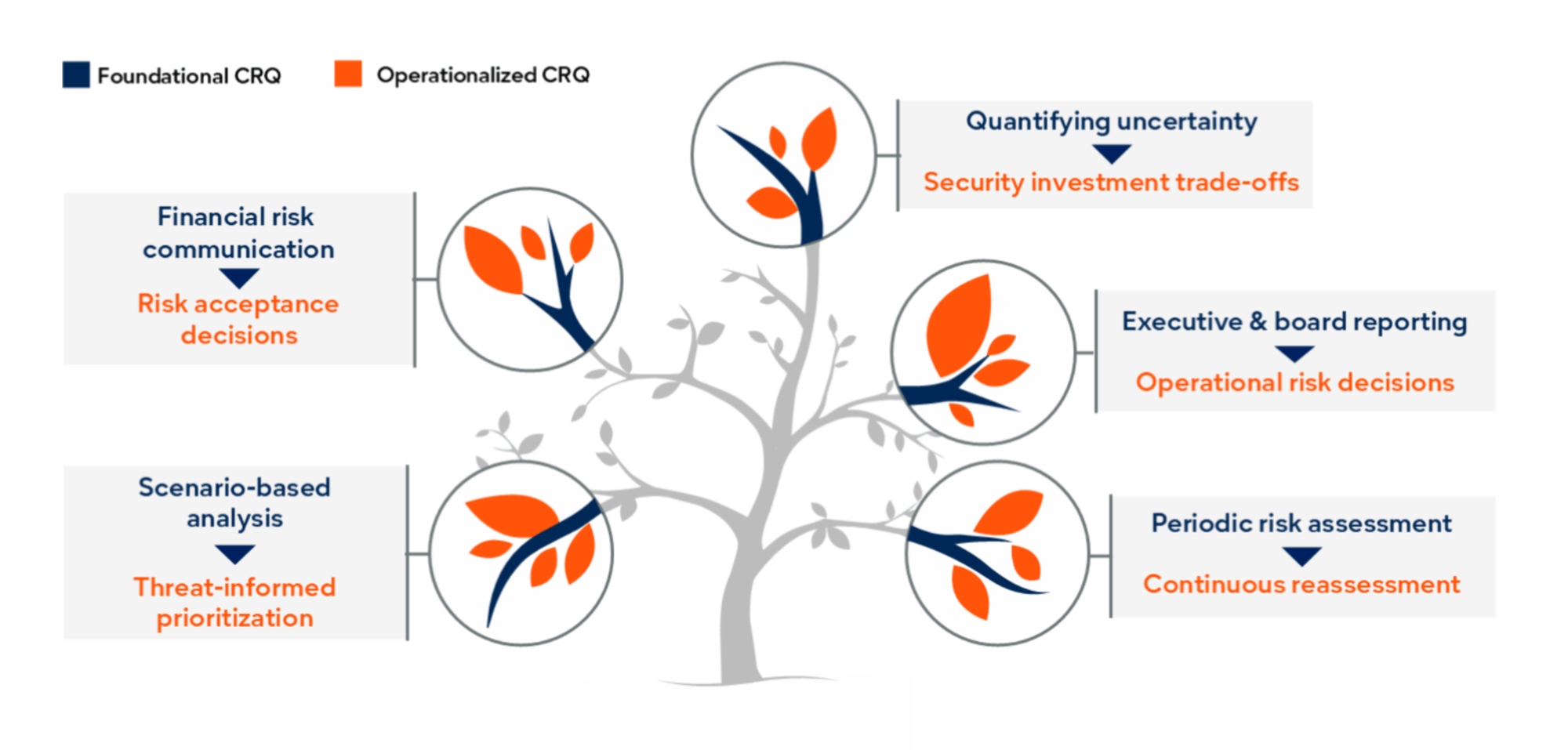
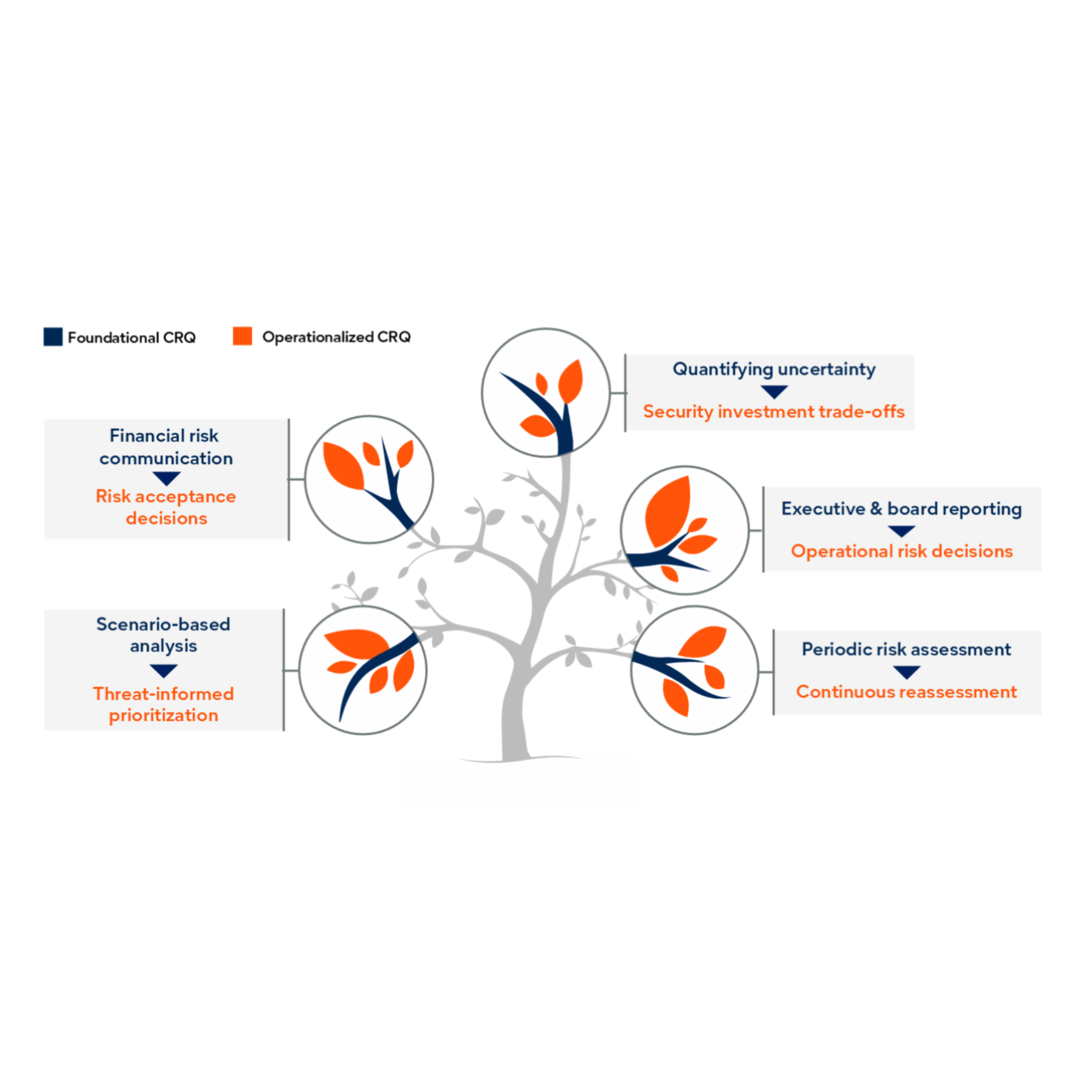
Foundational CRQ focused primarily on executive reporting, scenario analysis, and financial risk communication. Operationalized CRQ extends that foundation by incorporating continuous operational evidence, including exposure validation, attack path analysis, threat-informed testing, and control effectiveness measurements. The result is a more dynamic and responsive understanding of cyber risk that reflects actual operating conditions rather than static assumptions.
This evolution mirrors a broader shift occurring throughout the cybersecurity industry. Historically, cyber risk assessments were performed annually or quarterly, often relying on expert judgment and qualitative scoring mechanisms. Today’s organizations operate in environments where exposure conditions change continuously. Cloud infrastructure evolves daily. Third-party ecosystems expand and contract. AI introduces entirely new categories of risk.
In this environment, organizations require risk intelligence that is as dynamic as the threat landscape itself. Quantification is increasingly becoming part of a continuous decision-support process rather than a point-in-time assessment.
Better Decisions Under Uncertainty
One of the most important observations in the Gartner report appears in the figure below, where Gartner states that the goal of CRQ is “better decisions under uncertainty.”
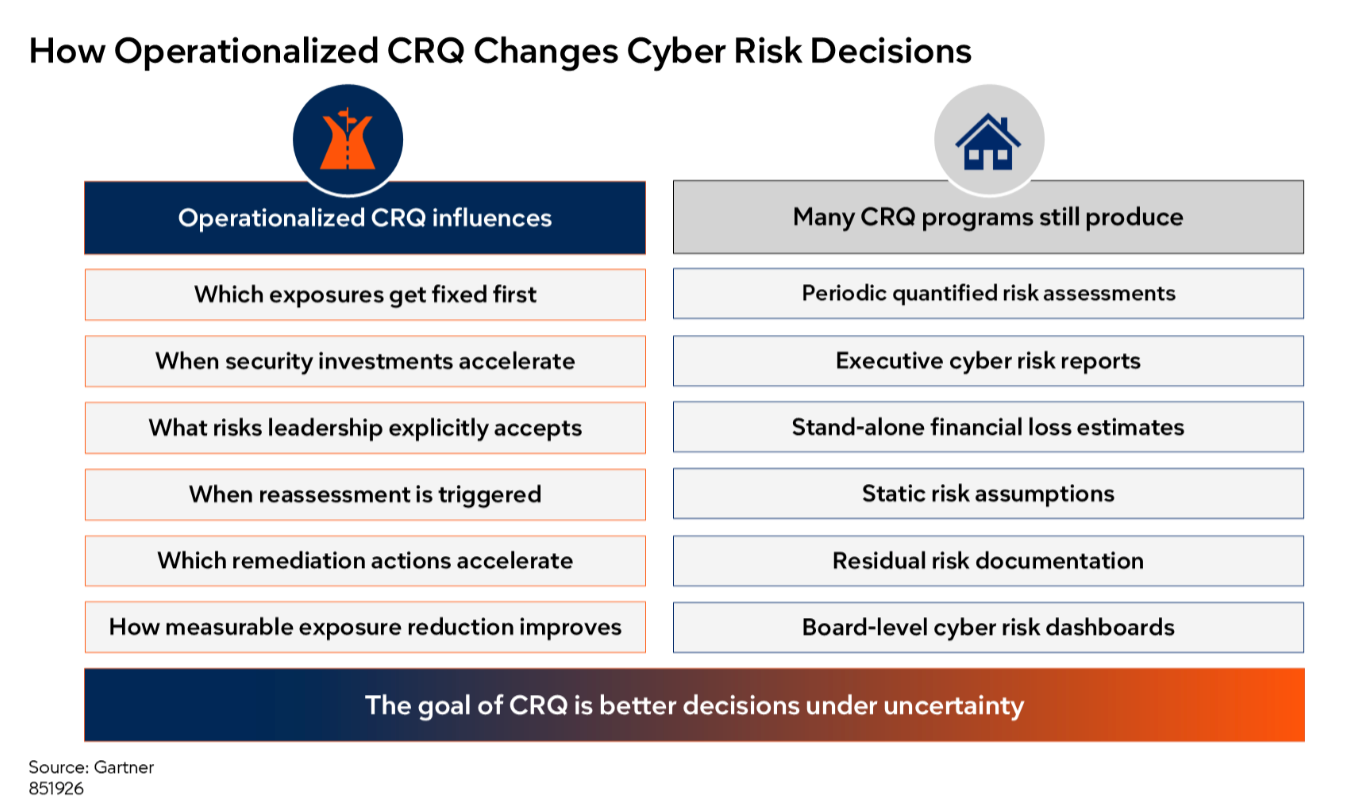
That statement captures the essence of FAIR.
FAIR was never designed to eliminate uncertainty. Quite the opposite. Uncertainty is an inherent characteristic of risk. The objective of quantitative analysis is not to predict the future with precision, but to help decision-makers understand the range of possible outcomes and make more informed choices.
This distinction matters because one of the most common misconceptions about CRQ is that it seeks mathematical certainty. In reality, CRQ is a decision-support discipline. As Gartner correctly points out, quantified outputs should inform decisions, not replace them. Human judgment, governance oversight, and business context remain essential components of effective risk management.
The true value of CRQ lies not in producing a number, but in creating transparency around assumptions, uncertainty, trade-offs, and potential business outcomes. That is what enables better decisions.
Why Adoption Is Accelerating
The report also highlights the growing regulatory and governance pressures driving CRQ adoption.
Regulations such as the SEC cybersecurity disclosure requirements, DORA, and NIS2 do not explicitly mandate cyber risk quantification. However, they increasingly require organizations to demonstrate a defensible understanding of cyber risk, materiality, business impact, resilience, and risk governance. At the same time, boards, regulators, insurers, and executive teams are demanding risk information expressed in business terms rather than technical metrics.
As a result, organizations are finding it increasingly difficult to rely solely on qualitative heat maps, maturity scores, and subjective assessments when making important risk decisions. Quantification provides a common language that bridges the gap between cybersecurity professionals and business leaders.
Why This Matters for Boards and Executives
Perhaps the most important implication of Gartner’s report is not what it says about cybersecurity—it is what it says about business decision-making.
For years, boards and executive teams have struggled to gain a clear understanding of cyber risk. Traditional cybersecurity reporting has often relied on vulnerability counts, maturity assessments, control coverage metrics, and qualitative heat maps. While these measures can provide useful operational insights, they rarely answer the questions that executives are ultimately responsible for addressing.
What is our most significant cyber risk? How much financial exposure does it create? Which investments will reduce that exposure most effectively? Which risks are we willing to accept? How do we know whether our cyber risk posture is improving?
These are fundamentally business questions, not technical questions.
This is why Gartner’s emphasis on decision support is so important. When cyber risk is quantified in financial terms and connected to real-world operational evidence, security leaders gain the ability to communicate with boards and executive teams using the language of business. Discussions shift away from technical severity ratings and toward business impact, investment trade-offs, and risk-adjusted decision-making.
This capability is becoming increasingly important as boards face heightened expectations from regulators, shareholders, customers, and insurers. Whether responding to SEC disclosure requirements, demonstrating compliance with DORA or NIS2, or evaluating the risks associated with AI adoption, executive leaders need a defensible and transparent way to understand cyber risk in business terms.
Ultimately, the value of CRQ is not that it produces a financial number. The value is that it creates a common language through which cybersecurity leaders, business executives, and boards can make better decisions together.
That is why the evolution from foundational CRQ to operationalized CRQ matters so much. It is not simply an advancement in risk analysis. It is an advancement in corporate governance.
The Next Chapter: Continuous Cyber Risk Intelligence
Perhaps the most important takeaway from Gartner’s report is that the future of cyber risk management is not about producing better reports. It is about enabling better decisions.
The first phase of the market was proving that cyber risk could be quantified. The second phase was driving adoption of structured methodologies such as FAIR. The third phase—the phase we are entering now—is operationalization.
Organizations will increasingly demand continuous cyber risk intelligence, dynamic assessments of changing exposure conditions, threat-informed risk analysis, and decision-support capabilities that connect cybersecurity activities directly to business outcomes. Quantification is evolving from a reporting tool into an operational capability.
In many respects, cyber risk quantification is becoming cyber risk management.
The future belongs to organizations that can continuously understand how changes in their environment affect risk and can rapidly translate those insights into informed action. The organizations that succeed will not simply quantify risk periodically; they will operationalize cyber risk intelligence as a core business capability.
Final Thoughts
As Founder of the FAIR Institute, I view Gartner’s report as validation of the tremendous progress our profession has made over the last decade. I also view it as confirmation of where the profession is headed.
The industry has moved beyond asking whether cyber risk can be quantified. The more important question now is how effectively organizations can operationalize cyber risk intelligence to improve decisions every day.
I applaud Lampis Alevizos, Pedro Pablo Perea de Dueñas, Deepti Gopal, and the Gartner team for producing a thoughtful assessment of where CRQ stands today and where it is headed next.
The future belongs to organizations that can translate cyber risk intelligence into better business decisions. That has always been the promise of FAIR—and it is encouraging to see that vision increasingly reflected across the broader cybersecurity industry.
Join the Conversation at FAIR Conference 2026
The themes highlighted in Gartner’s report—the operationalization of cyber risk quantification, the rise of continuous cyber risk intelligence, and the increasing importance of risk-informed decision-making—will be central topics at the upcoming FAIR Conference 2026, taking place October 6–7 in New York City.
Each year, FAIR Conference brings together hundreds of CISOs, cyber risk leaders, board members, regulators, practitioners, and researchers to share real-world experiences, emerging best practices, and the latest innovations in cyber risk management. This year’s conference will place a particular emphasis on how organizations are operationalizing FAIR, scaling cyber risk quantification programs, addressing AI-related risks, strengthening third-party risk management, and enabling better executive and board decision-making.
If Gartner’s report resonates with you and your organization is exploring how to move from foundational quantification to operationalized cyber risk intelligence, I encourage you to join us.
The future of cyber risk management is being shaped right now. FAIR Conference 2026 is where many of those conversations will happen.
Register today for FAIRCON26 and join the world’s largest gathering of cyber risk professionals.
.jpg)