Most boards believe they are overseeing cyber risk. Most CISOs walk out of the boardroom wondering whether anything they said landed. Both can't be right.
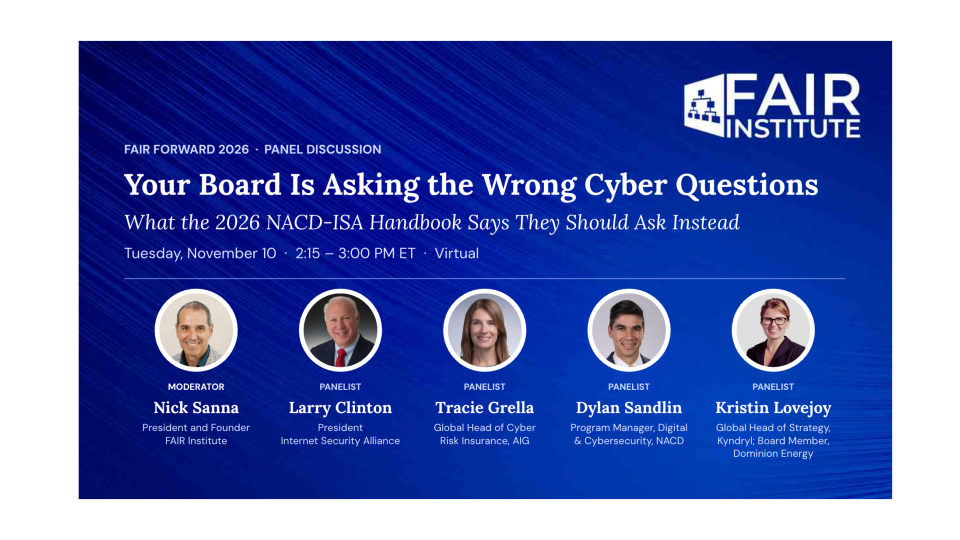
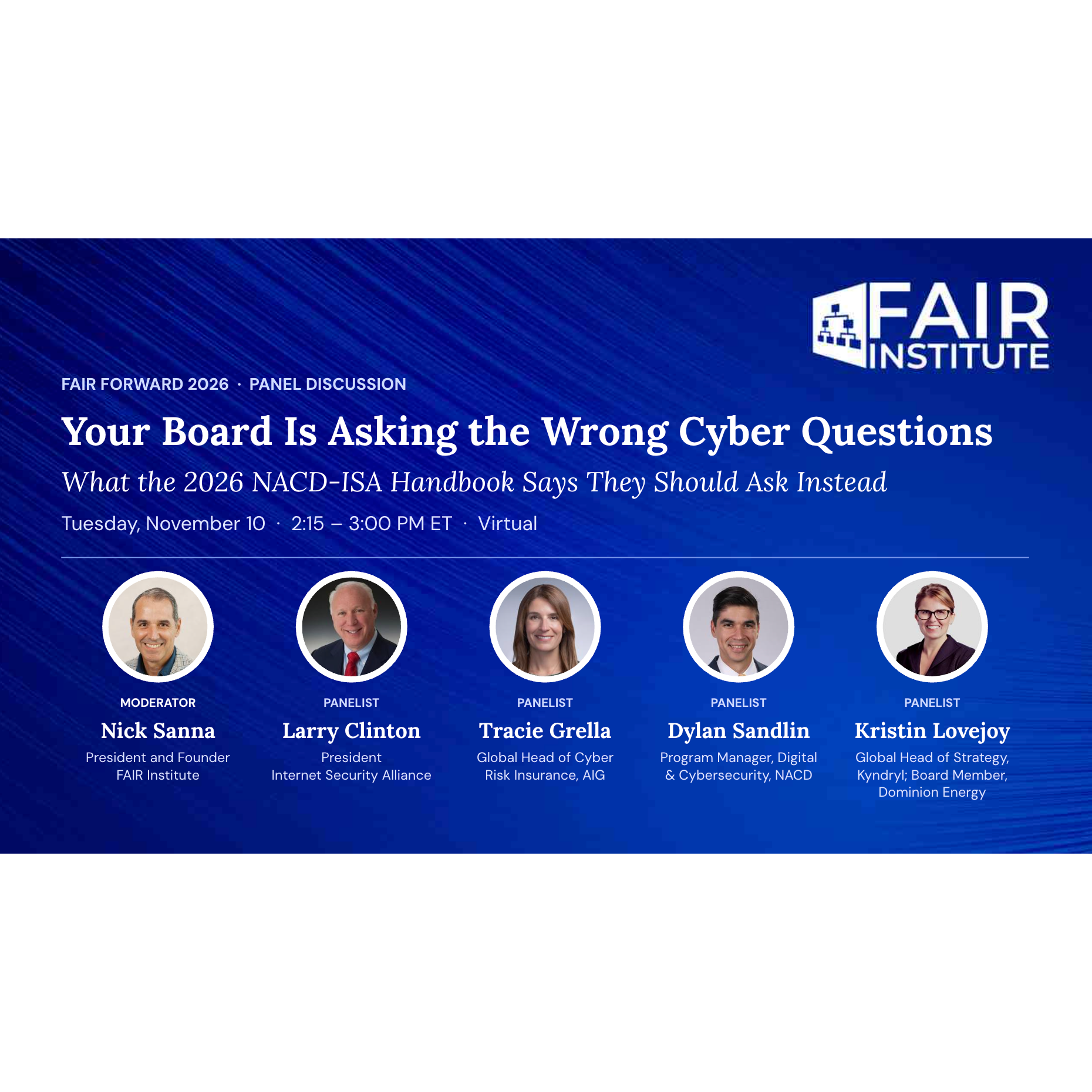
That tension was the starting point for a discussion at the FAIR Forward 2026 event, Your Board Is Asking the Wrong Cyber Questions: What the 2026 NACD-ISA Handbook Says They Should Ask Instead. The NACD-ISA Director's Handbook on Cyber Risk Oversight is the reference directors actually read, now in its fifth edition. So we brought together the people who wrote it, a CISO who now sits on boards, and an insurer who prices cyber risk in dollars every day:
- Larry Clinton, President and CEO of the Internet Security Alliance (ISA) and a driving force behind the Handbook across its editions
- Dylan Sandlin, Program Manager of Digital and Cybersecurity Content at the National Association of Corporate Directors (NACD), the Handbook's co-publisher
- Kris Lovejoy, who has presented to boards as a CISO and now sits in the director's chair herself; she is Global Head of Strategy at Kyndryl
- Tracy Grella, Global Head of Cyber Risk Insurance at AIG
The promise to risk practitioners was simple: by the end, you'll know what your board will be asking you, and how to help them ask it. Here is a taste of what the panel delivered.
The principles held. The world around them didn't.
I opened by asking Larry Clinton what boards got wrong that forced a rewrite. He pushed back on the premise right away: this is an update, not a rewrite, and the distinction matters.
The Handbook's core principles have been independently assessed by PwC, MIT and the World Economic Forum, and found to produce real security improvements for the organizations that use them. Those principles stay. What changes are the toolkits boards use to apply them. The 2023 edition had two sections on artificial intelligence; by 2026 both needed to be updated and expanded, alongside a new section on quantum and new guidance on overseeing emerging technologies.
So where do boards fall short? Larry was careful not to blame them. Leading boards are applying the principles well. The stress points are the ones FAIR practitioners know intimately: putting cyber risk in business terms, blending economics with technology, and actually measuring it. Add the AI era and the coming quantum era, and boards, like the rest of us, have to keep running just to keep pace.
"You can't just secure your own organization." Cybersecurity, Larry reminded us, needs a whole-of-ecosystem solution that reaches across the supply chain.
If a director reads only one page
Dylan Sandlin represents the people who actually read the Handbook, so I asked him: if a director reads just one page, which should it be? He cheated and gave us two, and both are a direct invitation to risk professionals.
Page 21, Principle 4: risk appetite. Boards need to work hand in hand with management to define a risk appetite statement. Coming straight from NACD's director summit, Dylan's read was clear: directors are hearing this guidance, but many aren't sure how to apply it. That gap is the opening for risk professionals to start the conversation.
Page 24, Principle 5: reporting risk to the board. This section spells out what good looks like: concise, quantitative, forward-looking reports that let the board connect risk information to strategic outcomes.
Read together, those two pages describe exactly what quantified cyber risk management is built to deliver. An appetite expressed in business terms, and reporting that measures exposure against it.
What directors say they're missing
How much of a CISO's board presentation do directors actually find useful? Dylan didn't have to guess: NACD surveys its members on exactly this. Directors consistently report room for improvement in the cyber risk reporting they get from management.
The most revealing finding: directors feel management is transparent and does a good job flagging potential financial exposures. Where they see the biggest gap is in tying those risks to strategic objectives.
Metrics, KPIs and KRIs are part of the answer, but Dylan boiled it down to three things every risk professional should bring into the boardroom:
- What makes the business special. Your organization's real value proposition in the market.
- What is existential to that value. Which risks could put it in jeopardy, and how it might be vulnerable.
- What management is doing about it. The mitigation plan for the risks that threaten that value.
This framing does three jobs at once. It aligns the board and management on strategy. It sets a materiality threshold for what reaches the board. And it opens a dialogue where management can explain its rationale and walk through the scenarios it sees.
Governance or governance theater?
Many boards still send cyber risk to the audit committee and hear about it from technologists. So I asked Dylan directly: is that oversight, or are we outsourcing it?
His answer reframed the question as real governance versus governance theater, and gave practitioners a set of tests to tell the difference:
- Agenda time. Agenda time is scarce, so when a board dedicates it to cyber, that's a strong signal it takes the risk seriously.
- The right people on the committee. If cyber sits with a committee, does that committee include members with cybersecurity or technology expertise?
- A documented charter. Is oversight of cyber risk actually written into the committee's charter?
- Full-board integration. Is cyber part of strategic discussions at the full board, and do committee report-outs give the board something it can act on, rather than staying siloed?
On the perennial question of cyber expertise on boards, the Handbook offers a practical test: weigh the need based on alignment with the organization's strategy and the criticality of the risk. Given how central technology now is to strategic success, Dylan expects that test to push more expertise onto boards.
Where directors lean too hard on management
Asked where directors over-rely on management's word, Dylan didn't hesitate: emerging risks and emerging technologies. It takes time for directors to come up to speed on something new. His counsel is to bring in outside experts so the board keeps the independent perspective its fiduciary duty requires.
For risk professionals, he framed this as an opportunity. Reporting on quantum, AI, or the cyber implications of an M&A deal should carry an educational component. Done well, it builds trust between the board and management and keeps directors focused on what matters most.
From CISO to director: what Kris Lovejoy wishes she'd known
Kris Lovejoy has stood at the front of the boardroom as a CISO, and now she asks the questions as a director. Her reflection on what she learned was disarmingly candid.
Video Link
As a CISO, she had read COSO and COBIT. She thought she understood what directors cared about and the context they operated in. Then she became a director, and discovered the role was not quite what she had imagined.
She had been preparing to help directors oversee cyber risk without understanding the broader business context they were working in: the strategy, and the full range of risks they had to manage. The result, in her own assessment, was information that was often too generic. It talked about cyber risk, but not within a strategic business context, and not in language that connected risks and remediations to things directors actually cared about. She always felt, as she put it, "a little bit off-kilter."
The questions she used to dread
Then I asked which board questions she dreaded as a CISO. Every practitioner watching will recognize them:
Are we okay? Have we done enough? Are we protected? Are we safe? Do you need more resources?
Open-ended questions with no answerable form. And this is where the conversation really gets going: what Kris now asks as a director instead, and how Tracy Grella's view from the insurance side shows what cyber risk actually costs.
What this means for risk practitioners
In just the opening minutes, the people who wrote the Handbook and the people who live by it converged on the same message:
- Your board is asking for quantified, forward-looking reporting. It's written into Principle 5. A heat map won't meet that bar.
- Risk appetite is the open door. Directors know they need one and aren't sure how to build it. Help them define it in business terms.
- Strategy is the missing link. Directors say the biggest gap is connecting cyber risk to strategic objectives. Start from what makes the business valuable, and work back to what threatens it.
- Emerging tech is where you can lead. On AI and quantum, boards need education as much as reporting. Bring both.
- Replace "Are we safe?" with questions you can answer. Give your board the vocabulary of exposure, appetite and return on mitigation, and it will start asking the right questions.
That is exactly what FAIR was built for.
Watch the full discussion
This is only a short clip. The full session goes much further, including what Kris Lovejoy now asks as a director, how Tracy Grella and AIG put a dollar value on cyber risk, and what the Handbook says boards should ask instead.
The full recording is available in the FAIR Institute Resource Center for Contributing Members. Not a Contributing Member yet? Upgrade your membership to unlock the complete FAIR Forward library, get a complimentary copy of the book "From Heatmaps to Histograms", plus discounts on FAIR training and FAIRCON.
The 2026 NACD Handbook on Cyber Risk Oversight can be downloaded here.